
%20(2).png)
Why We Changed Our Math Curriculum to Better Meet the Needs of Our Neurodivergent Students

At Anniston Academy, we believe being committed to our students means being willing to make changes when something is not serving them as well as it could.
Last year, we used Singapore Math. There were parts of the program we valued, particularly its visual models, manipulatives, and concrete-to-pictorial-to-abstract approach. Those strategies helped many students develop a stronger conceptual understanding of math, and we will continue using them when they benefit our students.
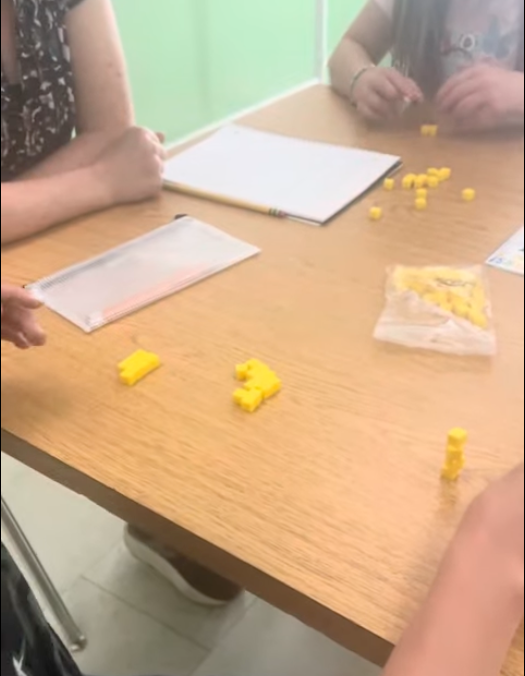
However, as our teachers and clinical team worked with the curriculum, we learned more about what our students needed from a complete math program. Our classrooms include students with autism, dyslexia, ADHD, language-processing differences, intellectual disabilities, working-memory challenges, and highly uneven academic profiles. Some students may understand complex mathematical concepts while struggling to retrieve basic math facts. Others may solve a problem using manipulatives but have difficulty explaining their reasoning verbally. Students within the same classroom may also be working at very different instructional levels.
We found that we needed a curriculum with more built-in differentiation, intervention support, assessment options, and flexibility. After reflecting on our experience last year and discussing the needs we were seeing across classrooms, our team decided to transition to Reveal Math.
A Collaborative Decision
This was not a decision made by one person, and it was not a criticism of the teachers who implemented our previous curriculum. It was a collaborative process involving the people who work directly with our students.
Our educators, clinicians, support staff, and school leadership considered what was working, where students were encountering barriers, and what teachers needed to respond more effectively. We looked beyond whether a curriculum was considered academically strong in general and asked a more important question:
Is this the strongest fit for the students we actually serve?
For us, Reveal Math was the better answer.
Why Reveal Is a Better Fit for Our Students
Reveal provides several ways to teach and practice the same mathematical concept. Students can learn through manipulatives, visual models, teacher demonstrations, guided instruction, written examples, real-world applications, discussion, and digital supports.

That matters because our students do not all access learning through the same pathway. If a student does not understand the first explanation or representation, the teacher has other options available without having to create an entirely new lesson.
Reveal also offers more built-in support for:
Students who are missing prerequisite skills
Students who need additional modeling and guided practice
Students working below, at, or above grade level
Teachers managing several instructional levels within one classroom
Ongoing assessment and progress monitoring
Targeted intervention and additional practice
Enrichment for students who are ready to move further
This gives our teachers a consistent schoolwide framework while still allowing instruction to be individualized.
Building on Reveal With IXL
Another important part of our decision was how easily Reveal Math aligns with IXL, a learning platform our students already know and genuinely enjoy using. IXL offers Reveal-specific skill plans that connect lessons and concepts from the curriculum with corresponding IXL activities. This allows our teachers to reinforce what students are learning in class through targeted, interactive practice.
For our students, engagement matters. When children enjoy the platform they are using, they are often more willing to practice, persist through challenging skills, and return to concepts that require additional repetition. IXL also provides immediate feedback, visual supports, and individualized practice opportunities, helping students build confidence while strengthening their skills.
Used together, Reveal and IXL allow us to extend learning beyond the initial lesson. Teachers can assign practice connected to the current concept, provide additional support for prerequisite skills, or offer more advanced work to students who are ready for it. Students receive more opportunities to practice in a format they enjoy, while teachers gain additional information about student progress. IXL does not replace direct instruction from our teachers. Instead, it strengthens and extends the instruction students receive through Reveal Math.
Making Reveal Accessible
Choosing Reveal does not mean placing a workbook in front of every child and expecting every student to complete the same assignment in the same way.
We adapt the curriculum based on each student’s academic, communication, sensory, and developmental needs. Those accommodations may include:
Reading directions and word problems aloud
Reducing unnecessary or confusing language
Breaking assignments into smaller sections
Visually marking each step of a problem
Explicitly teaching mathematical vocabulary and symbols
Pairing spoken directions with pictures, gestures, objects, or written models
Using manipulatives before expecting abstract computation
Providing number lines, multiplication charts, visual examples, or step cards
Allowing additional processing time
Reducing the number of practice problems without reducing the learning objective
Providing direct and guided instruction when open-ended discovery creates a barrier
Allowing students to point, match, draw, select, use AAC, manipulate materials, or calculate to demonstrate understanding
Separating reading ability, handwriting, speech, and processing speed from mathematical knowledge
Avoiding unnecessary timed work when speed is not the skill being measured
Students with dyslexia should not appear to be struggling in math simply because they cannot independently decode a word problem. Students who use scripts, echolalia, AAC, or limited spoken language should not be required to give a traditional verbal explanation as the only way to prove that they understand a concept. Our goal is to measure math, not a student’s ability to overcome an unrelated barrier during a math lesson.
Keeping What Worked
Changing curricula does not mean discarding every effective strategy we used last year.
We will continue incorporating manipulatives, number bonds, bar models, Montessori materials, visual instruction, and concrete-to-pictorial-to-abstract teaching when those approaches support the learner. Reveal will provide our comprehensive academic framework, while our teachers and clinicians will continue selecting the instructional tools that help each student succeed.
Growth Requires Reflection
We do not believe schools should continue using a program simply because it has already been purchased, selected, or implemented. Responsible education requires us to reflect honestly, listen to the professionals working directly with students, examine student needs, and make changes when a stronger option becomes available.
Our transition from Singapore Math to Reveal Math reflects that commitment. We learned from last year. We identified what our students and teachers needed. We made the decision together. Now we are moving forward with a curriculum that offers greater differentiation, stronger intervention resources, more assessment support, and more pathways for students to demonstrate what they know.
At Anniston Academy, changing course is not a sign that we failed. In fact, our students showed an average of 2 years of growth in Math, which is incredible. Changing course, for us, was a sign that we are working together as a multidisciplinary team and that we are paying attention.


Comments